
Religious Education at Fellgate
Subject Lead: Mrs L. Mitchinson
On this page, you can find information about our RE curriculum at Fellgate.
Intent:
At Fellgate Primary School we recognise and value the importance of Religious Education. Children will develop positive attitudes to their own and others’ beliefs, ideas, experiences,
feelings and values. Our teaching of RE enables children to develop a sense of self awareness, have respect for others, be open minded and show appreciation and wonder of the world in which we live. Children will flourish under the three key aims of: knowledge
and understanding, critical thinking and personal reflection. Children at Fellgate will also
develop a deepening knowledge and understanding about a range of religious and non-religious worldviews.
Implementation:
We follow the South Tyneside Agreed Syllabus for Religious Education (SACRE). Its three key aims are:
– Knowledge and Understanding
– Critical Thinking
– Personal Reflection
These elements are interlinked and enable pupils to make good progress in RE. In the Early
Years, children engage in RE activities through their study and acquirement of Understanding the World; with a focus on the key themes of ‘special’ and belonging’. In KS1 children learn about Christianity and Judaism and in KS2 children learn about Christianity, Hinduism, Sikhism, plus a small special study of Islam. RE is taught in a respectful and positive environment where children can express and celebrate their ideas and beliefs. Philosophical approaches enable children to learn to think critically and understand that some questions have no definitive answer.
Impact:
Knowledge and Understanding – children will develop knowledge and understanding of what is meant by religion and the term ‘religious and non-religious worldviews’ and the impact these have for individuals and communities. It involves investigation of and enquiry into the nature of religion and differing belief systems.
Critical Thinking – Children will use their reasoning to analyse and evaluate claims that
religious and non-religious worldviews make. Through learning in this way children will have
the opportunity to give opinions, support their ideas with reason and listen to and respond
to the views of others. Critical thinking requires the children to be open minded and to value
the varied reasons and ideas people use when exploring an issue and giving their views.
Personal Reflection – Children will develop their ability to reflect on religious and nonreligious worldviews in relation to their own beliefs, values and experiences and the influence of these on their daily life, attitudes and actions. Personal reflection makes a significant contribution to the children’s spiritual, moral, social and cultural development.
Inclusion and Equal Opportunities:
Our curriculum is fully inclusive and all children can succeed in RE. Children are encouraged
to share and listen to the views, opinions and thoughts of others in a non-judgemental and open environment. We support ranging needs, celebrate cultural diversity and make learning relevant through linking content to the context of our school and children. Where necessary, small changes are made to the delivery of lessons to ensure all learners make good progress. All children are challenged to deepen their understanding through critical thinking.
Subject Mantra:
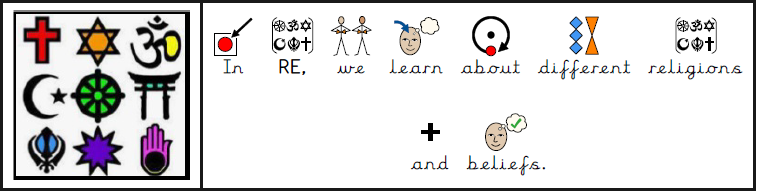
We use subject mantras to develop our children’s understanding of the subjects they are learning. They also help our children make connections and develop their long term memory.
Here, you can find out about our RE Policy that will tell you more about the subject and how
it is taught, monitored and assessed across the school.
Long Term Plans: