
Maths at Fellgate
Subject Lead: Mrs A. Storey
On this page, you can find information about our maths curriculum at Fellgate.
Intent:
At Fellgate Primary School, we foster positive can do attitudes and we promote the fact that ‘We can all do maths!’ We believe all children can achieve in mathematics and we build on skills and knowledge in a step by step and progressive way; teaching for a secure and deep understanding of mathematical concepts through manageable steps. As a school, we embrace the Mastery approach to teaching mathematics. Our teachers will ensure that mathematical skills are taught every day following an exciting and purposeful Maths curriculum. They also use cross curricular opportunities to develop pupils’ mathematical fluency; providing real life contexts to further embed key skills. Our pupils understand the importance of mathematics, are encouraged to be confident in numeracy and apply the skills that they learn to a range of problem-solving activities. Our aim is for all children to become fluent in the fundamentals of mathematics so that they develop conceptual understanding and the ability to recall and apply knowledge rapidly and accurately. Our teachers will use a CPA approach when delivering lessons so that our pupils can ‘see the Maths.’ Arithmetic is taught during our Maths lessons when appropriate and arithmetic skills are revisited during our wider Maths timetable. We ensure that all children have the opportunity to reason their mathematical thinking and deepen their understanding through a Mastery approach. Our pupils become resilient and independent learners through using mistakes and misconceptions as an essential part of learning. Teachers will use a range of resources to plan and deliver effective lessons whereby all children can achieve. There are extra activities throughout the year to promote mathematical skills.
Implementation:
At Fellgate, we follow a Mastery for Maths curriculum using White Rose Maths Hub resources; based on ‘the Five Big Ideas.’ This means that children are not streamed by ability because we expect all children to be given the opportunity to achieve age related expectations. In our mixed age classes, pupils are taught their curriculum age group. Children in our Resource Base follow our whole school curriculum but also have individual Maths targets based on their needs.
Mastery teaching provides our children with the time to acquire a deep and transferable understanding of mathematical concepts. Our teachers use an episodic approach which: ensures our pupils take an active role in their learning, embeds reasoning throughout and the children move together through a lesson. At Fellgate, our pupils are scaffolded effectively using a CPA approach as well as being challenged through using ‘Answer, Prove, Explain (A.P.E.)’ and the use of star challenges to really deepen their understanding and make connections between mathematical structures.
We appreciate how important it is for our children to become fluent in all aspects of calculation, therefore, each session must include dedicated time to practicing arithmetic/times tables and a revisiting of prior knowledge through a Core Four activity in Key Stage Two and Year Two. In EYFS and KS1, our pupils follow the Mastering Number Programme to create secure firm foundations in the development of good number sense and the automaticity of number facts.
Introducing the concept
As a school, we believe that mathematical understanding is achieved by using, exploring and investigating. Therefore, children are introduced to new concepts by the use of concrete objects to help them make sense of it. New concepts should always be introduced with a link back to objectives covered previously; building on prior knowledge and skills. Children will be given many opportunities to make links between embedded and new learning. Scaffolds (such as new vocabulary and representations) should be included on the Maths Working Wall.
Sequence of learning
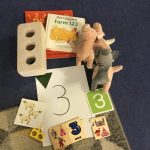
Concrete, pictorial, abstract (CPA) is a highly effective approach to teaching that develops a deep and sustainable understanding of maths. It allows pupils to ‘see the Maths and not just do the Maths.’ The CPA approach underpins our teaching of Mathematics at Fellgate Primary School.
The Concrete Step of CPA
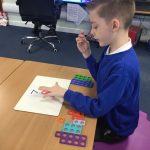
Concrete is the ‘doing’ stage. During this stage, children use concrete objects to model problems. Unlike traditional maths teaching methods where teachers demonstrate how to solve a problem, the CPA approach brings concepts to life by allowing children to experience and handle physical (concrete) objects. For example, if a problem involves adding pieces of fruit, children can first handle actual fruit. From there, they can progress to handling counters or cubes which represent the fruit.
The Pictorial Step of CPA
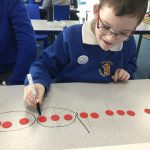
Pictorial is the ‘seeing’ stage. Here, visual representations of concrete objects are used to model problems. This stage encourages children to make a mental connection between the physical object they just handled and the abstract pictures, diagrams or models that represent the objects from the problem.
Building or drawing a model makes it easier for children to grasp difficult abstract concepts (for example, fractions). Simply put, it helps students visualise abstract problems and make them more accessible. It also allows pupil to make connections between the mathematical structures.
The Abstract step of CPA
Abstract is the ‘symbolic’ stage where children use abstract symbols to model problems. The abstract stage involves the teacher introducing abstract concepts using only numbers, notation, and mathematical symbols (for example, +, –, x, /). Although CPA is understood as three distinct stages, our staff will go back and forth between each stage to reinforce concepts. Concrete and Pictorial representations are used alongside abstract concepts to deepen our pupils’ understanding and allow them to make connections.
Impact:
Our monitoring proves that the Maths curriculum provides children with:
- Learners who can clearly explain their reasoning and justify their thought processes
- Quick recall and automaticity of facts and procedures
- The flexibility and fluidity to move between different contexts and representations of mathematics
- The ability to recognise relationships and make connections in mathematics
- The opportunity to solve problems using real-life and meaningful contexts
- The skills to be happy, confident, articulate and autonomous mathematicians with a life-long passion for learning.
A mathematical concept or skill has been mastered when a child can show it in multiple ways, using the mathematical language to explain their ideas, and can independently apply the concept to new problems in unfamiliar situations.
Inclusion and Equal Opportunities:
All children can and will succeed in Maths. Our curriculum is fully inclusive and supports ranging needs and cultural diversity. We adapt the curriculum content and resource appropriately to enable all children to make progress in Maths.
National Curriculum Programme of Study
Awards and Quality Marks:
We are currently working with The Great North Maths Hub.
Subject Mantra:
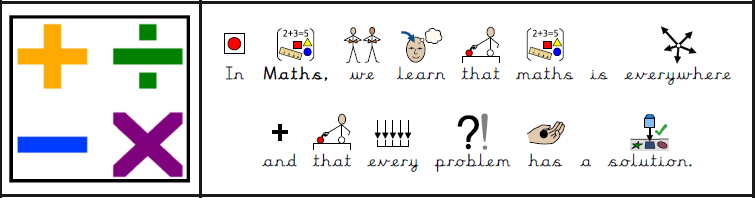
We use subject mantras to develop our children’s understanding of the subjects they are learning. They also help our children make connections and develop their long term memory.
Here, you can find our Maths Policy that will tell you more about the subject and how it is taught across school.
Long Term Plan: